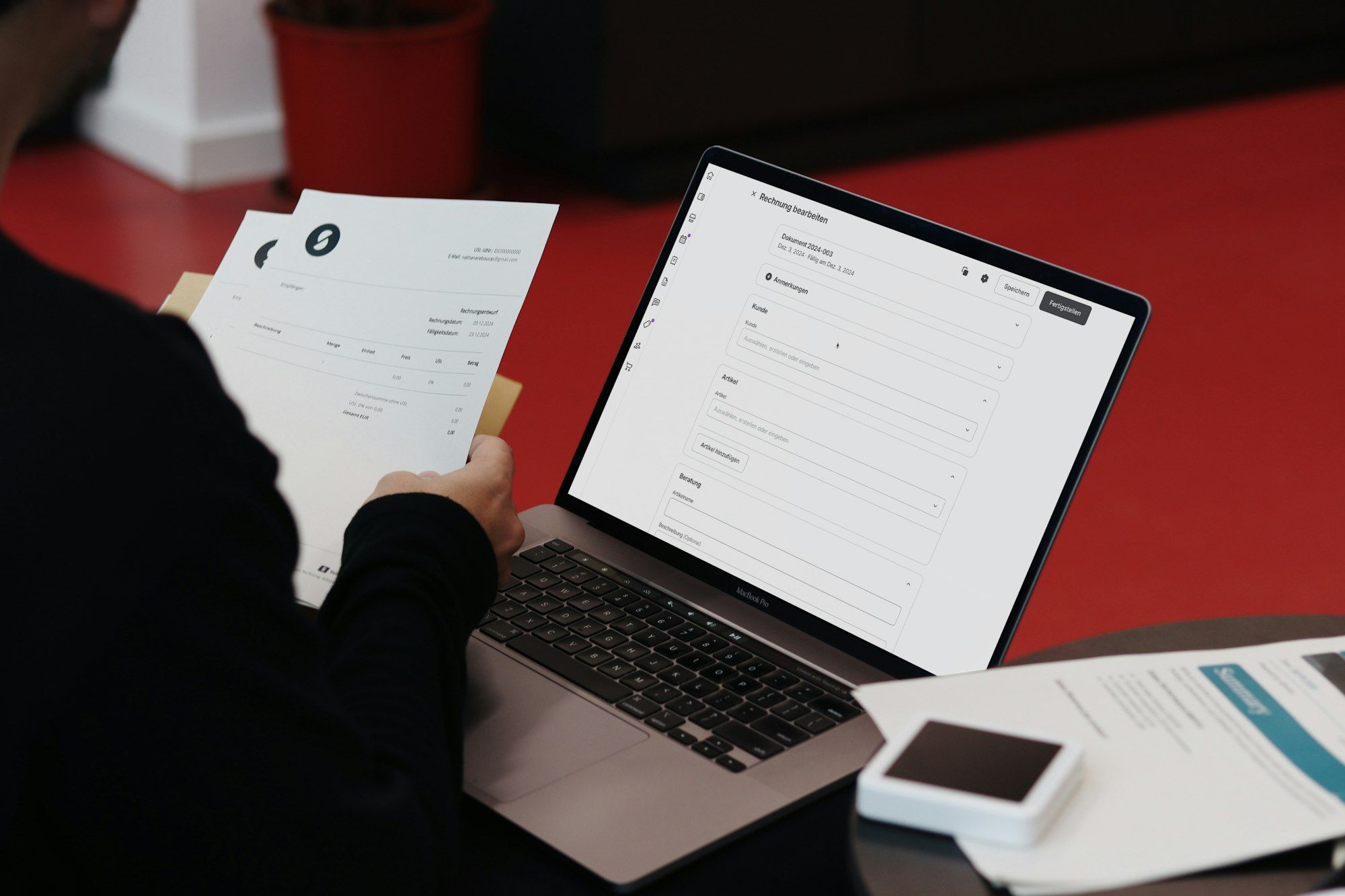
Invoice finance turns the money your customers owe you into working capital you can use now. You’ve already done the work and sent the invoice, so why wait 30, 60 or 90 days to put that money to work? With invoice finance, FastBiz Loans can arrange up to 85% of an invoice’s value upfront, with the rest released once your customer pays. It grows with your sales, which makes it a natural fit for B2B businesses on the way up.
This page shows how invoice finance works with a worked example, then untangles the terms you’ll hear: factoring vs discounting, disclosed vs confidential, and single-invoice vs whole-ledger.
How does invoice finance work?
Invoice finance works by advancing you most of an invoice’s value as soon as it’s issued, then settling up when the customer pays. Your unpaid invoices act as the security. Here’s the cycle:
- You do the work and invoice your customer on your normal terms, say 30, 45 or 60 days.
- You submit the invoice to the finance provider, along with the customer’s details.
- You receive an advance of up to 85% of the invoice value, often within a short time once your facility is set up.
- Your customer pays the invoice on their usual schedule.
- The balance is released to you, less the provider’s fees.
Once a facility is running, this becomes routine. New invoices go in, advances come out, and your cash flow starts to look like your sales rather than your customers’ payment habits. Our guide on how invoice finance works walks through the mechanics in more depth.
A worked example
Let’s put some numbers to it. These are illustrative only and leave fees out, because every facility is priced on the individual business and its customers.
Example scenario — illustrative only. A Perth labour-hire business completes a month’s work for a mining services client and issues a $40,000 invoice on 45-day terms. Wages for that work have already gone out.
| Stage | What happens | Cash to the business |
|---|---|---|
| Day the invoice is issued | Invoice submitted for finance | — |
| Advance | Up to 85% of $40,000 | Up to $34,000 |
| Waiting period | Client pays on its normal 45-day terms | — |
| Customer pays | $40,000 received against the invoice | Remaining $6,000, less fees |
Instead of carrying $40,000 of wages for six weeks, the business can have up to $34,000 working for it straight away, ready to cover the next payroll or take on another contract. The fees are the cost of that speed, and your lending specialist will show them clearly before you commit.
Factoring vs discounting: what’s the difference?
The difference is who collects the money from your customers. That single detail changes how visible the arrangement is and how much admin you keep.
| Invoice factoring | Invoice discounting | |
|---|---|---|
| Who chases payment | The finance provider manages collections | You keep collecting as usual |
| Does the customer know? | Yes | Usually not |
| Admin load on you | Lighter — collections are handled for you | You run your own credit control |
| Often suits | Smaller or fast-growing businesses without a credit controller | Established businesses with solid systems and a strong debtor book |
Neither is better across the board. If chasing overdue invoices eats up your week, factoring can hand that job over. If your customer relationships are sensitive and your accounts team is strong, discounting keeps everything in-house.
Disclosed vs confidential: what will your customers see?
With a disclosed arrangement, your customers are told that invoices are being financed and are asked to pay into a nominated account. Your invoices usually carry a note with the new payment details. In most industries this is routine, and plenty of large corporates and government buyers deal with it every day.
With a confidential arrangement, your customers pay into your usual account (often one controlled for the purpose) and don’t see the finance at all. Confidential facilities typically need a more established business with good records and a well-spread debtor book.
In either case, your relationship with the customer stays yours. A good facility shouldn’t change how your clients feel about working with you.
Single invoice or whole ledger?
This is about how much of your debtor book you finance.
Selective or single-invoice finance. You pick which invoices to fund, when you need to. It’s flexible and suits businesses with occasional big jobs or lumpy cash flow. For example, a Brisbane events company might finance one large corporate invoice ahead of a busy season, then not use the facility again for months.
Whole-ledger finance. Your whole debtor book is included, and the available funding rises and falls with your total invoices. It suits businesses that invoice constantly and want a standing working capital line that grows with sales.
| Question to ask yourself | If yes, lean towards |
|---|---|
| Do I only need help with the occasional large invoice? | Selective / single-invoice |
| Do I invoice many customers every week? | Whole ledger |
| Do I want funding that automatically grows as sales grow? | Whole ledger |
| Do I want to keep the arrangement to specific customers? | Selective / single-invoice |
Who is invoice finance best for?
Invoice finance suits businesses that sell to other businesses or government on credit terms, usually 30 to 90 days, and are growing faster than their customers pay. It’s especially common in:
- Labour hire, recruitment and staffing
- Wholesale, distribution and manufacturing
- Transport, freight and logistics
- Construction subcontracting with clear invoicing (progress claims are assessed case by case)
- IT, consulting, marketing and other professional services
- Cleaning, security and facilities contractors
When it’s probably not the right fit:
- Most of your sales are to consumers, paid on the spot or by card
- Your invoices are frequently disputed or subject to heavy retentions
- You have one small customer who pays irregularly
- You need a one-off lump sum for something unrelated to sales, like a fit-out
If you’re weighing a facility against a lump sum, our comparison of invoice finance vs a business loan sets out the trade-offs, and working capital loans covers the other ways to bridge the gap.
What do lenders look at for invoice finance?
With invoice finance, your customers are as important as you are. Lenders look at:
- Who owes you money: the size and reliability of your debtors. Invoices to established businesses and government bodies tend to be viewed most favourably.
- Concentration: whether one customer makes up most of your ledger.
- Invoice quality: clear, undisputed invoices for completed work, with standard payment terms.
- Payment history: how quickly your customers have actually paid in the past.
- Your business basics: trading history, an active ABN, a business bank account and an Australian resident director or owner.
A tidy aged debtors report, the list of who owes you what and how overdue it is, is the most useful single document you can provide.
What you’ll need to apply
- 3–6 months of business bank statements, shared securely online
- Photo ID and your ABN or ACN
- An aged debtors report from your accounting software
- Copies of the invoices you want to finance and your customers’ details
- Financial statements, if the facility is over $150,000
Speed tip: invoice finance needs debtor details, so export your aged debtors report before you enquire. It saves a round of back-and-forth.
How fast can invoice finance be set up?
The first setup takes a little longer than a simple loan; after that, funding individual invoices is usually quick. Here’s why, so you can plan around it.
When a facility is first arranged, the provider checks your business, then checks your customers and the invoices themselves. That can include confirming that the work has been completed and that the invoice isn’t disputed or already financed elsewhere. It’s a one-off piece of groundwork, and the better your records, the faster it goes.
Once the facility is in place, the routine is short: upload the new invoice, it’s checked against the approved customer, and the advance follows. Many businesses find that after the first few weeks, invoice finance becomes one of the least effortful parts of their month.
Five habits that get the most from invoice finance
- Invoice promptly. The day the work is signed off is the day the invoice should go out. Every day of delay is a day of cash you don’t have.
- Keep invoices clean. Clear descriptions, correct purchase order numbers and agreed terms reduce disputes, and disputed invoices usually can’t be funded.
- Spread your customers. A book that isn’t dominated by one client is stronger security and can support more funding.
- Use the cash to grow. The best use of an advance is taking on the next job, not plugging an old hole.
- Watch the cost against the benefit. If faster cash lets you win work, buy materials at better prices or skip late fees elsewhere, it’s earning its keep.
For a broader look at how cash moves through your business, see the working capital cycle explained.
Get paid for the work you’ve already done
If you’re waiting on invoices while opportunities pass by, invoice finance can close the gap. Start your 60-second enquiry, and a lending specialist will help you choose between single-invoice and whole-ledger, disclosed and confidential, based on how your business actually runs. Pricing is set on your business’s individual situation, and we look for the sharpest option available.
Your path to funds
Step 1
60-second online enquiry and a call with a lending specialist
Step 2
Share bank statements, ID and an aged debtors report
Step 3
Your customers and invoices are checked
Step 4
Up to 85% of eligible invoice value is advanced
Step 5
Customer pays; the balance comes back to you, less fees
Questions we get asked
Is invoice finance the same as debtor finance?
Yes, in everyday use. Debtor finance is the umbrella term for borrowing against the money your customers (your debtors) owe you. Invoice finance, invoice factoring and invoice discounting are all forms of it.
Will my customers know I'm using invoice finance?
It depends on the arrangement. With disclosed finance or factoring, customers are told to pay into an account managed by the finance provider. With confidential invoice discounting, you keep collecting as normal and customers usually aren't told. Confidential options are typically reserved for more established businesses.
Can I finance just one invoice?
Often, yes. Selective or single-invoice finance lets you choose which invoices to fund, which suits businesses that only occasionally need to speed up cash, such as after landing a large contract with long payment terms.
What if my customer doesn't pay?
Most invoice finance in Australia is arranged so that if a customer doesn't pay, your business remains responsible for the amount advanced. Some providers offer bad-debt protection as an extra. Ask your lending specialist exactly how non-payment is handled before you sign.
Can I use invoice finance if I sell to consumers?
Generally no. Invoice finance relies on invoices issued to other businesses or government bodies with clear payment terms. If most of your sales are to consumers over the counter or on card, a merchant cash advance or line of credit is usually the better fit.
Does my credit history matter as much with invoice finance?
It still matters, but the strength of your customers matters a lot too, because they're the ones paying the invoices. Businesses with reliable, creditworthy customers can sometimes access invoice finance more readily than other types of business finance.